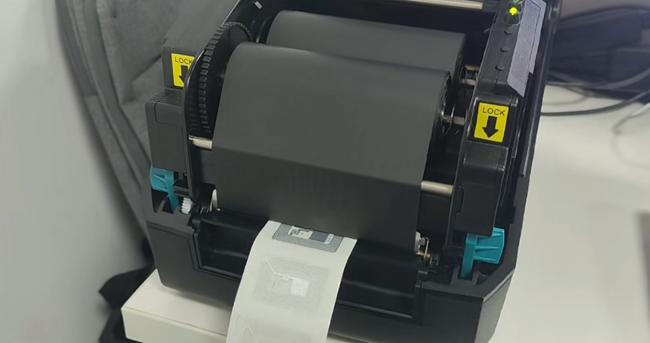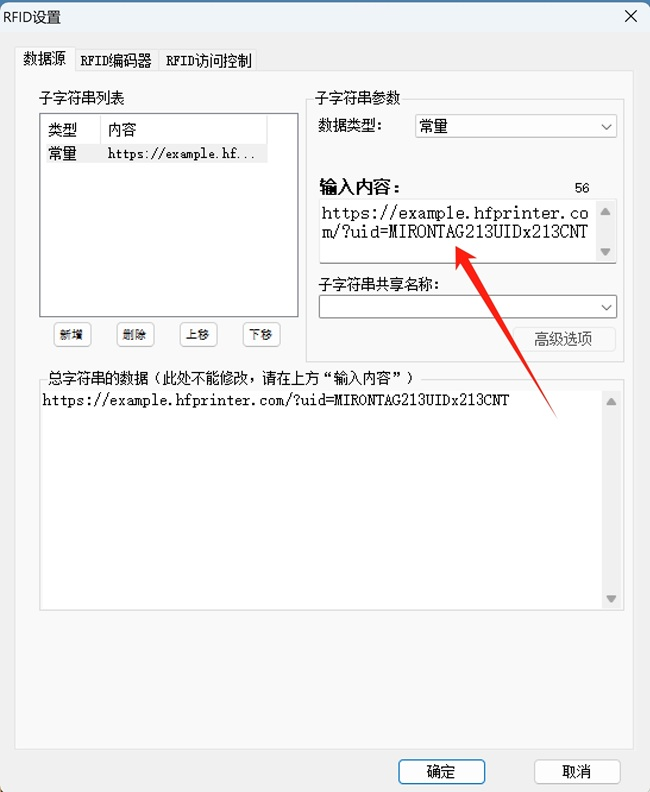
With this version of the software, you can batch print and write data via ZMIN's HF label printers (such as X1C, X1iC, F3C, etc.) while enabling the label UID mapping or counter function. No complex secondary development is required; simply add the corresponding keyword in the software's data source to batch-write or print output.
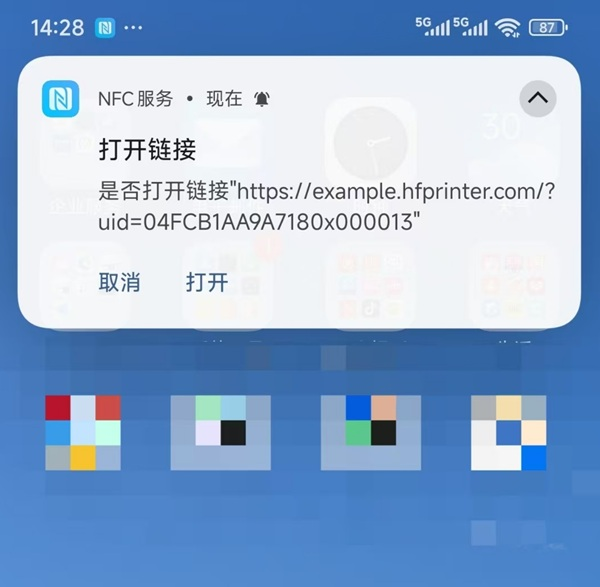
Keyword to enable both UID and counter mapping for Ntag213: MIRONTAG213UIDx213CNT Keyword to enable UID mapping for Ntag213: MIRONTAG213UID Keyword to enable the counter for Ntag213: 213CNT Keyword to enable both UID and counter mapping for Ntag215: MIRONTAG215UIDx215CNT Keyword to enable UID mapping for Ntag215: MIRONTAG215UID Keyword to enable the counter for Ntag215: 215CNT Note: When enabling UID mapping or the counter separately, only one of them can be enabled. Examples: 1. Write NDEF URL: https://example.hfprinter.com/?uid=MIRONTAG213UID Data read back after writing: https://example.hfprinter.com/?uid=042D56DA242090 2. Write NDEF URL: https://example.hfprinter.com/?Counter=213CNT&Test=1 Data read back after writing: https://example.hfprinter.com/?Counter=000001&Test=1 3. Write NDEF URL: https://example.hfprinter.com/?uid=MIRONTAG213UIDx213CNT Data read back after writing: https://example.hfprinter.com/?uid=042D56DA242090x000002
Application scenarios: The UID mapping and counter functions of NTAG213 or NTAG215 are widely used in the following scenarios. Combining security and automation features, they mainly serve fields such as identification, anti-counterfeiting and traceability, and interaction management: 1. Product anti-counterfeiting and traceability UID mapping: Map the 7-byte UID to the user area (such as NDEF data) in ASCII format for quick reading of the unique identifier, used for anti-counterfeiting verification of high-value goods such as luxury goods and pharmaceuticals. For example, scanning the tag directly displays the product serial number, which is verified against a database. Counter function: Record the number of times the tag is read; abnormal growth (such as multiple scans in a short time) may indicate counterfeiting. The counter value can also be mapped to the user area and combined with the UID for dynamic traceability. 2. Smart marketing and user interaction UID mapping: In advertising posters or product labels, the UID can be associated with user identity (such as a member ID) to trigger personalized content (such as showing an introduction on the first scan and pushing offers later). Counter function: Count user contact times and analyze advertising effectiveness. For example, optimize placement strategies through count data, or unlock interactive content at different stages (such as giving a discount after 3 cumulative scans). 3. Device pairing and access control UID mapping: Mirror the UID into NDEF data for quick pairing of Bluetooth/Wi-Fi devices (such as a smart speaker reading a tag to connect automatically). Counter function: Limit the number of pairing attempts (such as locking the tag when the counter exceeds a threshold) to prevent brute-force cracking. It needs to be combined with the password protection function (NFC_CNT_PWD_PROT) to improve security. 4. Inspection and asset management UID mapping: In labels on industrial equipment or public facilities, the UID serves as the unique asset number and, after mapping, facilitates quick identification by inspection systems. Counter function: Automatically record the number of inspections (incremented on the first read after each power-on) to ensure regular maintenance. The counter value can be directly integrated into inspection reports via ASCII mirroring. 5. Electronic ticketing and membership systems UID mapping: Map the UID of tickets or membership cards to the user data area for quick identity verification (such as reading the UID at concert entry to match ticket purchase information). Counter function: Limit repeated use of tickets (such as incrementing the counter at each entry), or count the frequency of member visits.