I. What is an RFID label?
RFID stands for Radio Frequency Identification. RFID is a communication technology that can identify specific targets and read/write related data via radio signals, without requiring mechanical or optical contact between the identification system and the target.
The most important advantage of RFID systems is contactless identification. They can read and write tags through snow, fog, ice, paint, dust, and other harsh environments where ordinary barcodes cannot be used, and read/write speed is extremely fast - in most cases less than 100 milliseconds.
RFID labels, i.e., electronic labels using RFID technology, currently fall into three main categories: passive RFID labels, active RFID labels, and semi-active RFID labels.
Labels that can be printed with RFID barcode printers are all passive RFID labels, and the vast majority of electronic labels used in jewelry management are also passive RFID labels.
II. Differences between RFID labels and traditional barcode labels
Although every piece of jewelry uses a hangtag label, most current jewelry management systems are still based on traditional 1D or 2D barcodes. With the development of RFID technology and falling RFID label costs, more and more jewelry merchants want to move from barcode applications to RFID technology.
Compared with barcode technology, RFID technology has the following advantages:
1. RFID label inventory counting is much faster than barcode counting. Traditional barcode label identification relies on optical signals, requiring a barcode scanner or PDA to scan each barcode to enter information; a single jewelry inventory count at a counter or store may take several hours. RFID labels rely on radio frequency signals and support simultaneous identification of multiple RFID tags, far more efficient than barcode identification, greatly reducing inventory time and improving work efficiency.
2. RFID technology has little dependence on label size and shape. Unlike barcode labels, it does not impose high requirements on label material, shape, and print clarity to improve reading accuracy. With RFID labels, even if the surface is worn, reading of the built-in chip data is unaffected.
3. RFID labels have a longer reading distance. HF labels have a reading distance similar to barcode identification, generally 3-10 cm, while UHF labels can reach 3-10 meters, enabling large-area label inventory without excessive movement.
4. RFID labels have strong wear and contamination resistance, and chip data can be retained for more than 10 years. Barcode labels mainly use paper as a carrier; their surface is easily worn or contaminated, causing incorrect data to be read.
5. Chip data in RFID labels can be rewritten repeatedly, allowing data to be added, modified, or deleted, which facilitates information updates. Traditional barcode labels cannot be changed after printing; when information changes, the label must be replaced.
6. RFID labels have greater data storage capacity. A 1D barcode generally holds less than 50 bytes, a 2D barcode generally less than 3,000 characters, while an RFID label can hold up to several megabytes. The greater the data capacity, the more information it can carry.
7. RFID labels are more secure. Each RFID label has a unique ID, and data content can be stored encrypted, making forgery difficult.
RFID technology can not only help an enterprise greatly improve the efficiency of goods and information management, but also interconnect sales enterprises and manufacturing enterprises, so that feedback information is received more accurately, demand information is controlled, and the entire supply chain is optimized.
III. How RFID technology optimizes jewelry management
Compared with traditional barcode management, jewelry supply chain management using RFID technology brings the following improvements:
1. Accurate sales data
In traditional jewelry store sales, sales staff often need to introduce jewelry information to customers one-on-one, and the store can only record data on jewelry already sold. With a smart display tray supported by RFID technology, the store can record inquiry data for each type of jewelry, and customers can see from the LCD screen in the tray information such as the jewelry's material, size, price, and how many times it has been viewed by other customers. This customer viewing data is transmitted to the store's back-end server, so decision-makers can more accurately understand which jewelry is more popular and better arrange display positions; jewelry designers can also use viewing and transaction data to design more styles that customers like.
2. Optimized inventory management
Jewelry is a high-value commodity, and the capital cost tied up in inventory is very high, so accurate and real-time inventory management is essential. With RFID technology, inbound and outbound management - including warehouse deliveries to stores and transfers between stores - can be quickly and automatically identified on an RFID reader-equipped workbench to complete handovers. Daily inventory counting is basic and very important work; RFID electronic labels enable rapid whole-tray or whole-cabinet counting, reducing workload and greatly improving efficiency.
3. Improved security
Using the globally unique ID of an RFID electronic label as the unique identity of a piece of jewelry, and associating the jewelry's attributes with the ID, enables anti-counterfeiting and anti-diversion management. UHF RFID electronic labels can also work with access control systems to provide anti-theft protection for jewelry.
IV. Introduction to RFID label printers
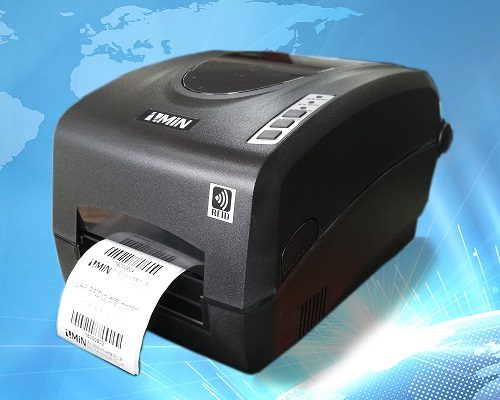
ZMIN RFID HF/UHF label printers are compact, full-featured, stable and durable, and print clearly. They can read TID information and write EPC data while printing, making them very suitable for RFID jewelry management applications.